-

2020-03-18
Covid took away the freedom to hangout with friends.
-
2020-01-01
As the ball dropped on New Year’s Day I embraced and kissed my boyfriend in excitement of what would await us in 2020, if only I knew. As we said our goodbyes to our friends we drove home on a side road to avoid the frantic traffic of drunk drivers and people rushing to get home. All I remember is driving in front of my boyfriend’s car and then waking up to him sobbing over me. My car lights were on, sunroof open, glass shattered everywhere, my blood stained on my wheel and purple bruises on ribs. Long story short I was smashed into by a drunk driver, my car flipped, rolled, and was finally crushed into a tree with me inside while my significant other watched it unravel before his eyes. This was my beginning to 2020 and I wished and hoped that it would only be better from there on but I was horribly wrong. On March 11th of 2020 I received an email from my university stating that it would be closed and urged all students to return home for the remainder of the semester. As many college students saw this as an extended spring break at the time we were all happy since it basically meant more partying. After week one passed of receiving the email I quickly realized that being isolated would be my downfall and it sure was.
By the end of the Spring semester I had failed a couple classes and was desperately trying to crawl out of a depressive episode. Since I am, or rather struggling to be a nursing student still, failing my Anatomy and Physiology I class sent me into a spiral of what ifs and how my GPA would recover from these failed courses. The realization of retaking these courses in order to save my future and using my only two chances of “erasing” my unsatisfactory grades crushed me. I was shattered by this reality but continued to push myself through Summer term to ace these courses, I studied day and night sacrificing friendships and days out for an A. As Summer came to an end Fall came and I barely passed the classes online because I struggled to adapt and truly retain the material meanwhile peers in my class were either completely giving up or cheating their way through the online, remote exams. To add the cherry on top, I was battling my university’s Housing Board in order to cancel my dorm agreement because many COVID cases had been recorded in my building and my roommates still went out to clubs while not wearing masks.
As the months passed and semesters came and went, I felt my sanity slipping and today I still sit in fear of my future. I struggle leaving my apartment due to the fear of exposure to COVID and accidentally passing it onto my only parent who suffers from lupus. This pandemic has truly crushed me and unfortunately it seems that I will be spending the remainder of my college life and 20s in this chaotic, barren, and lonely society where we only see each other screen to screen.
-

2021-02-24
Going around the school, there are signs and posters scattered around the entire vicinity, requiring masks and social distancing. Prior to any of these events, people were constantly together, with no masks, crowded rooms, etc. Now it is crazy to even fathom that I've been to a concert with thousands of people bumping into each other. Although this seems like a generic topic to discuss, I'm sure in the future it will seem so inconceivable.
-
2020-03-20
The date was March 20th, 2020. It was my best friend's birthday. Our friend group was preparing to throw a big party for her with lots of guests and food. We were all so excited for her to turn 18, finally able to vote. We were all also happy to be seniors and were looking forward to graduation and prom. March 20th will be forever cemented in my mind as the day it all went wrong. We found out that "Covid-19" was truly something very serious and our classes became virtual, no more seeing our friends in school. We couldn't have an in person birthday party for our friend, we couldn't hang out either. That day was so pivotal in all of our lives. We didn't know we would be stuck in quarantine for the next six months, we didn't know our graduation and prom would be canceled. We didn't know how much our daily lives would change. Sometimes, I wish I could go back to the pre-covid days. Everything seemed so simple then. No major pandemic, no masks, no overfull hospitals. But at the same time, as I reflect, quarantine has changed who I am as a person and has caused a lot of internal reflection and introspection. I feel like having to only see your family for six months makes you a better problem solver because you have to stay in the house and figure the issues out instead of going out and trying to brush it off. Overall, Covid is horrible and has caused so much loss. However, we need to also see the somehow positives that have come from this awful situation.
-

2021-02-24T13:24:52
Link to my Story
https://eaglefgcu-my.sharepoint.com/:w:/g/personal/vdearmas2389_eagle_fgcu_edu/EfbXTEMivQhBlns1iufe0PUBKjsdXqzsQvBkamaxWh4YAg?e=IwR5k3
-

2020-06-11
During the summer of 2020, the day before Shabbat, I decided to make challah during the quarantine. A friend of mine in Canada taught me the steps of making bread through FaceTime. It took all day to make, but once the challah was finally baked, I felt like a proud Jewish baker. This was a day that didn't feel boring like every other day in quarantine.
-
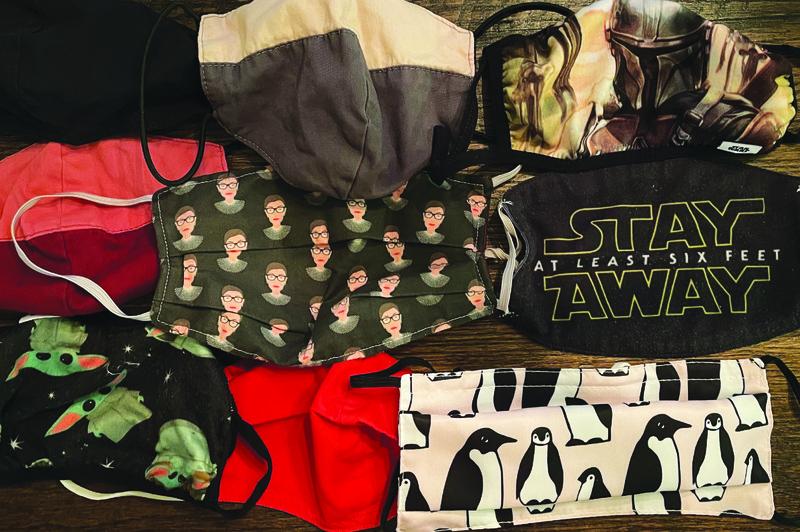
2021-02-24
Will we miss them when we no longer need them? What will become of these scrappy, sometimes brightly-colored statement pieces? In many ways, a mask has become the sartorial equivalent of a tie. Men still wear ties, but really…why? They serve no purpose. Will we do the same without masks? A mask can reveal who the wearer is in a way that a bare face cannot. Study the mudroom collection in this photo reveals and you will know that someone loves Star Wars and the other is a feminist who adores penguins.
After the Texas deep-freeze, and Ted Cruz’s air cruise to Mexico to escape the failure of the power grid, he returned to the U.S. hiding behind an enormous Lone-Star state face mask—as if donning it would make everyone forget his Marie-Antoinette moment. For future generations reading this: Cruz abandoned his constituents who were without power and water for days and flew to a Cancun resort with his family because they were cold. Did the mask hide his shame when he returned home after being caught? If so, maybe we should keep the mask in our wardrobes in our post-COVID futures. Perhaps the year of plague has given us a new fashion choice as well as a place to hide when necessary.
-

2021-02-23
The Cameron Art Museum and the Advocacy Project have teamed up to display quilts made by people around the world. These quilts depict the struggles their makers have faced during COVID-19. The museum is encouraging families to make their own COVID-19 quilt squares and return them to the museum. Returned squares will be made into a quilt that will be displayed at the museum for a limited time.
-

2020-02-24
In the beginning of the pandemic, I immediately realized how a large portion of the public was not focused on the virus itself, but the racial controversy of the virus' origin. This was unnerving to the core, because it is a fact that COVID-19 came from China. While it was unacceptable to accept this as fact, MERS literally stands for Middle Eastern Respiratory Syndrome. It is clear that there was a pro-CCP agenda being pushed in the background when propagating the "COVID Safety" spiel. As time went on, more and more inconsistencies began popping up. Beauty and barber shops closed, but Nancy Pelosi is more than welcome to get her hair done. Masks become required to enter any building or participate in society at all, but when the new President was sworn in, the spectators were sitting shoulder-to-shoulder and masks were few and far between. What my story says about the pandemic is that while we may have had a real potential global crisis, I believe things were skewed, twisted, and flipped so that it is most convenient for those who hold the power, and not done in the best interest of the American people. An example of this in real life was how the Los Angeles Lakers, Ritz Carlton, and Bank of America (per store) were able to get PPP loans, drain the pool of PPP money, and leave small business owners fighting for crumbs. I have linked a Washington Post article below that expands on the PPP loan problem and how our government failed small business.
The pandemic I fear will have long-lasting, Orwellian effects on our society in the sense that those in power will continue to use fear mongering to control the public through COVID. Even though a vast majority of the population has already had it and are building antibodies, Western European-style, 1940s era vaccination cards are beginning to circulate. I fear these cards will be the new "gold star" or "Scarlet Letter'', except those without it would be barred from society, rather than those with it. In my opinion, COVID today is what AIDS was in the eighties. Lots of unanswered questions, lots of fear, and government intervention so that free thinking is minimized. These three, and you have a perfect recipe for controlling the masses. Both diseases were politicized to death, and public opinion of the disease swung back and forth with politicization. If AIDS was blown up to the proportion that COVID was, I couldn't imagine the backlash the political and science communities would get from a certain demographic of people who are very vocal and have a statistically higher likelihood of contracting HIV. I hypothesize that pandemic would turn into pandemonium.
With that, my experience during quarantine was as expected. Mental health suffered due to lack of human interaction and ability to go outside, and physical health suffered due to inability to go outside and lack of motivation which was connected to mental health. The main positive thing from the pandemic I can identify is the performance of my stock portfolio. Even though I lost my job due to COVID, I was still able to afford rent, food, and supplies to stay hunkered down in my new $900/month prison for my three month sentence. Another big positive from the quarantine was my savings. The pandemic helped me realize how much unnecessary or emotional spending I do. It helped me point out lots of bad habits I have so I can work on fixing them. Things like spending money when I'm sad, and identifying vices that hold me back in my day-to-day. While the pandemic brought a lot of negatives to me and the world around me, I believe there are some positive things to take away from it. Opening your mind to more than what the government feeds you, appreciating every moment you have, embracing new hobbies, and learning how to maneuver through change. These are all things the pandemic has taught me, but if I had the option, I wouldn't do it again.
In terms of being a part of history, simply by living you are a part of history. I was at Sloan-Kettering in NYC with my family getting a life-extending cancer treatment for my father when 9/11 happened. He was one of three patients that day because while in surgery, the first plane hit the towers. The rest of the patients to be seen that day were canceled. I suppose the point I am trying to make is that history is subjective. 9/11 wasn’t 9/11 to me. 9/11 was the day I was blessed with enough time to make some foundational memories of my father before he passed. It can be argued that since I have been invested in GameStop since November, I was a part of history there too. I went to the Game 7 Cardinals vs. Red Sox World Series Game in Fenway Park. The game that broke the Bambino Curse. Again, it could be argued that I was a part of history there too, except my three year old self was asleep for the last two innings. History is subjective, and every day, everyday people like you and I make history. Historians and memoirists will use these events in the future to write articles, make movies and tv shows, write books, and extrapolate many other kinds of art from it. However, most often historical stories are told through a lens of subjectivity, and because of that, eventually all history becomes skewed to the point where it is indistinguishable from fable.
-
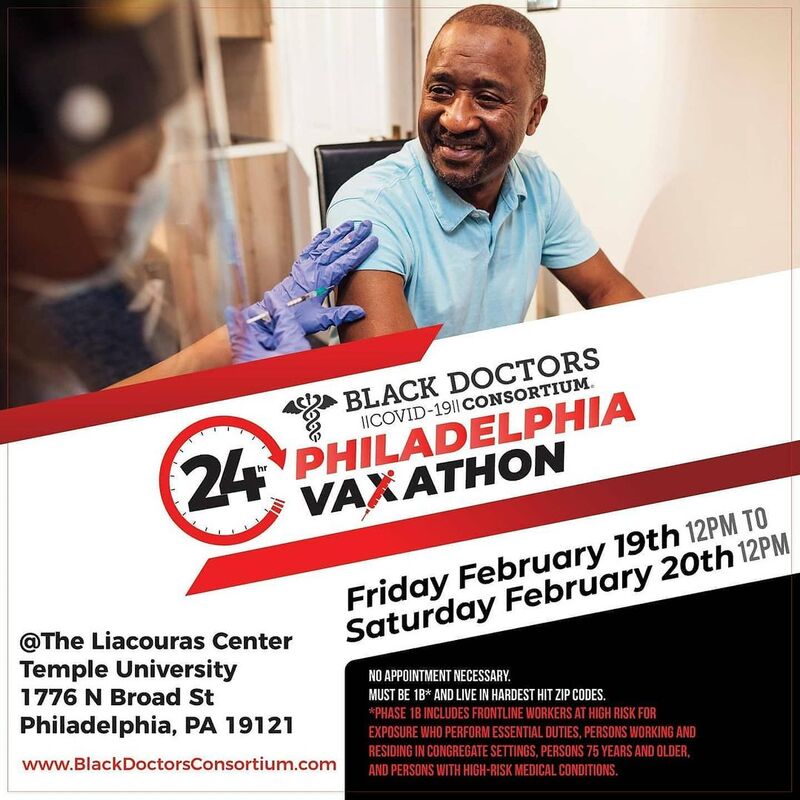
2021-02-18
The Black Doctors Consortium in Philadelphia, Pennsylvania planned to administer vaccines at the Liacouras Center at Temple University. It was to last 24 hours from Feb 19 12PM to Feb 20 12PM. It aimed to serve those who "live[d] in the hardest hit zip codes." No appointments were necessary. The original poster, handle @dralastanford, posted a series of photographs that helped answer some of the most frequently asked questions. These included the zip codes they were aiming for. These zip codes were specifically chosen as African Americans had "more than 50% of [the] death[s] related to COVID-19."
With so much confusion over the vaccine and how to get it, this organization tried to make it an easy process. They assured that there would be designated lines for those who pre-registered and those who didn't.
-

2021-02-19
The original poster updated their social media feed (Twitter), in the form of a thread, about the vaccination site at the Liacouras Center at Temple University in Philadelphia, Pennsylvania. The vaccines were administered by the Black Doctors COVID-19 Consortium (https://blackdoctorsconsortium.com/). The poster shared videos and photos of the people lining up to get their vaccines, which lasted hours.
Since the mission was to get people vaccinated, there were some who had pre-registered for it. Unfortunately, even some of those people still had to wait a long time. It's really saddening to see how everyone waiting had to wait in freezing weather, and it seems that if they left for food, the restroom, or otherwise, their spot would just be taken. As written in the last screenshot, there were thousands of doses still left to give at that point, and they weren't sure how long it would take to do so.
-
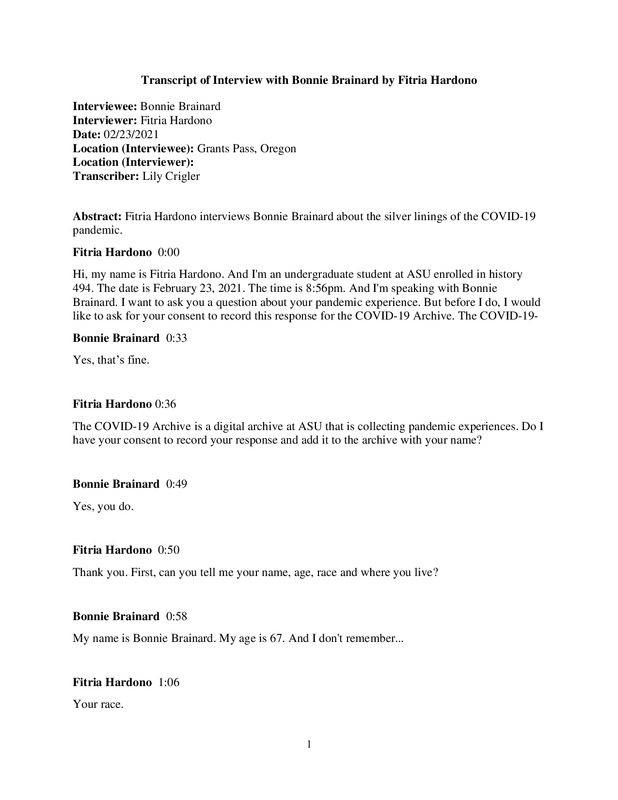
02/23/2021
I recorded a mini oral history with my former professor Dr. Beverly Van Note.
-

2021-02-24
The story that I submitted is just a small part in the grand scheme of things. COVID 19 has affected every part of how we live our lives. In countries like Thailand, tourism is crucial to their survival. Since the beginning of this virus, over 70% of businesses in Phuket, Thailand have shut down. More specifically though, the industry that has suffered the most throughout all of this is the sex industry. Whether you work at a massage spot, or walk the street at night, COVID and its restrictions set in place by the government have had detrimental effects.
-
2021-02-23
Only a little over 3% of the world's population has been fully vaccinated. How long will it really take to get everyone who wants to get the vaccine and be vacinated?
-
2020-02-23
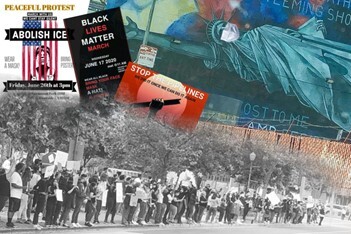
The COVID-19 pandemic has not stopped millions of people around the world from taking to the streets and organizing collectively against oppression and racism. Advocates, protestors, leaders and supporters from all backgrounds and walks of life are fighting many fronts to establish lasting social change, despite the dangers and rising infection rates.
These are historical movements within a historical moment- how are you fighting for social justice during this pandemic? And how has the pandemic affected your fight for social justice? Your contribution to the archives will ensure these battles and their ideology are preserved for future generations.
Your stories are valuable, and we hope that you will share them. Share your story here. Your voice will be archived alongside other stories of resilience and social justice efforts.
To make your story more visible, include the hashtag #SocialJustice with your description. Questions? Email Dana Lee Bell for more information. The link to submit is https://covid-19archive.org/s/archive/page/Share
-
2021-02-22
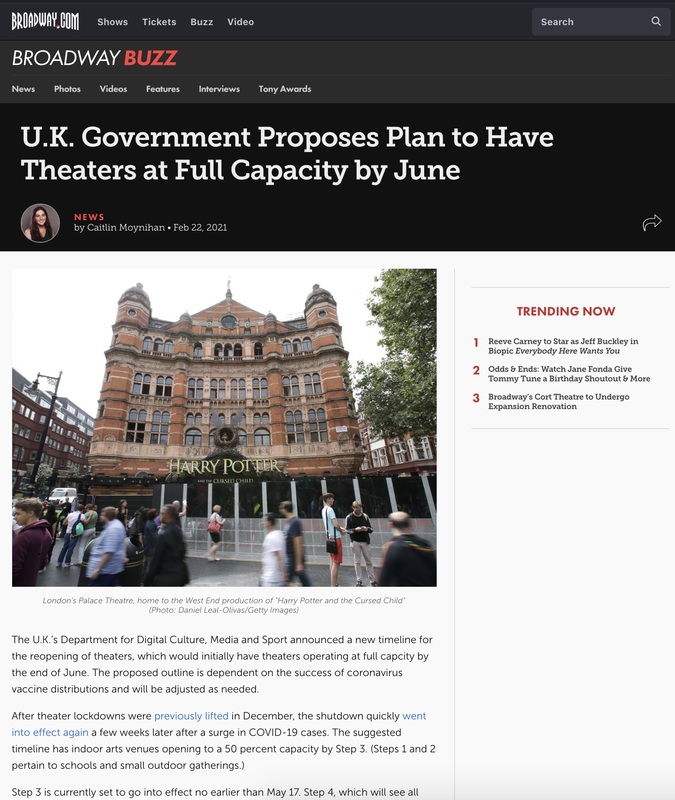
This article discuses how theaters in the UK are already partially open and are expected to be at full capacity by June 2021. This is in contrast to Broadway, which is closed in any capacity until May. I feel like this shows how detrimental the United States' response to COVID-19 in 2020 was and how it set us behind the rest of the world in returning to normalcy.
-
2020-04-04
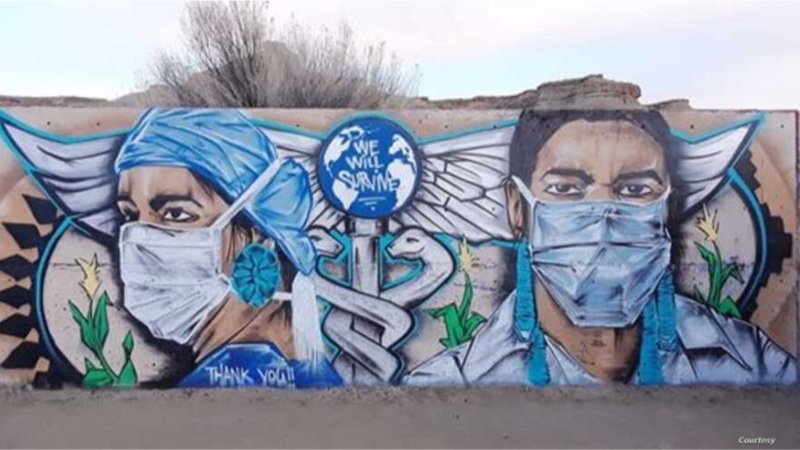
This photo is included as part of an article about the Navajo Nation's fight against COVID-19.
-
2021-02-23
Around March 2019 I was a freshman in college. At this time I was attending an HBCU in North Carolina 10 hours from where I live. Around this time Covid was relatively new and we didn't know much about it. About mid March the whole school received an email that we all had to pack up and leave campus by the following week and for some people that was easy because they lived either in North Carolina or in a close distance. After finding put this information I had to contact my parents and let them know of the situation. My family isn’t poor but we are not rich either so the finical stress that was put on them to call off of work and try and get some type of rental car big enough for all of my things without paying a bunch of money because we didn't have that to spend and rental companies already knew that this time was coming so of course they used it as a way to get more money my raising all the rental prices. So fast forward I come home and now were doing virtual school which was okay I really missed campus and my friends and class was so much more boring staring at a computer screen all day all the stores were closed it honestly felt like the world around me just completely stopped grocery stores closed no tissue or paper towels it was just everything happened so fast but I’m so grateful for my parents for coming to get me because they could of easily made me stay with a relative but they sacrificed a lot to get me home and I really appreciate it so much
-
02/22/2021
This interview is with medical profession Layne Williams who speaks about a positive aspect of the pandemic they noticed.
-
2021-02-22
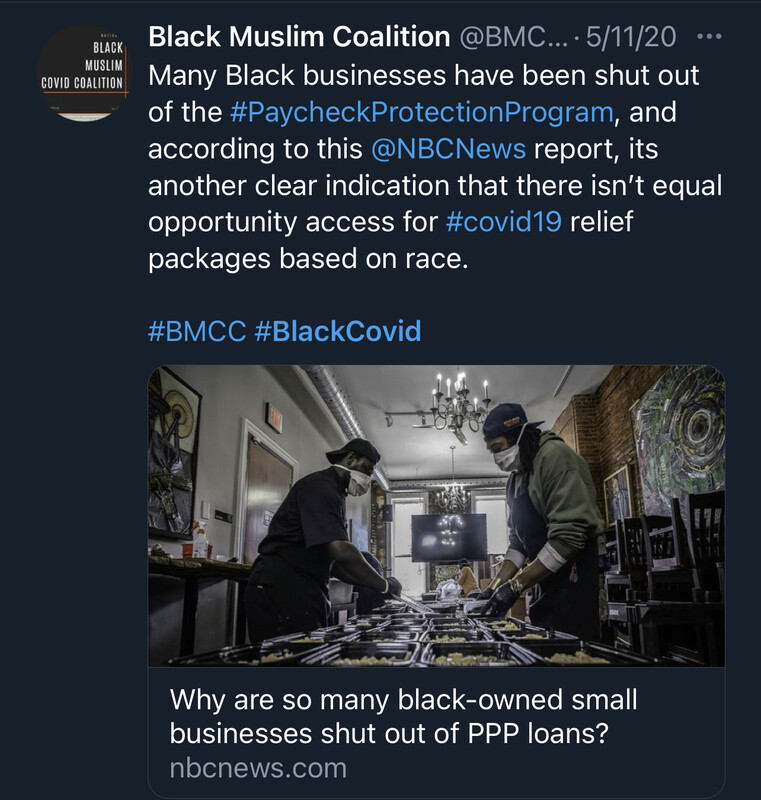
Though 60 billion is kept aside by CARES act funding for minority and other underserved borrowers, black-owned businesses are having trouble accessing the government's emergency Paycheck Protection Program loans. The corona virus loan program set 10 million in loans per customers that could be turned in to grants depending on individual profiles. but since its launch much controversy developed as with in minutes funds ran out to well resourced companies. Baltimore cafe owner Terence Dickson reached out to every on he knows as he was on his on last couple hundred to keep the staff paid. He states that the " financial industry has shown me no love for 20 years". He believes that the system should be different. This shows how small black owned businesses have continued to struggle through the pandemic even though the availability of loans and grants are there; but its still unavailable to reach them .
-
02/22/2021
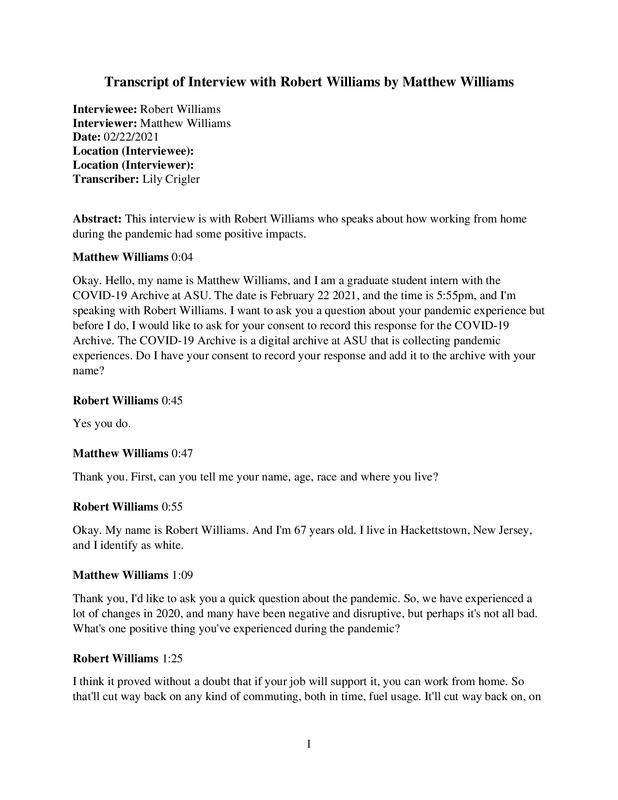
This interview is with Robert Williams who speaks about how working from home during the pandemic had some positive impacts.
-
2021-02-22
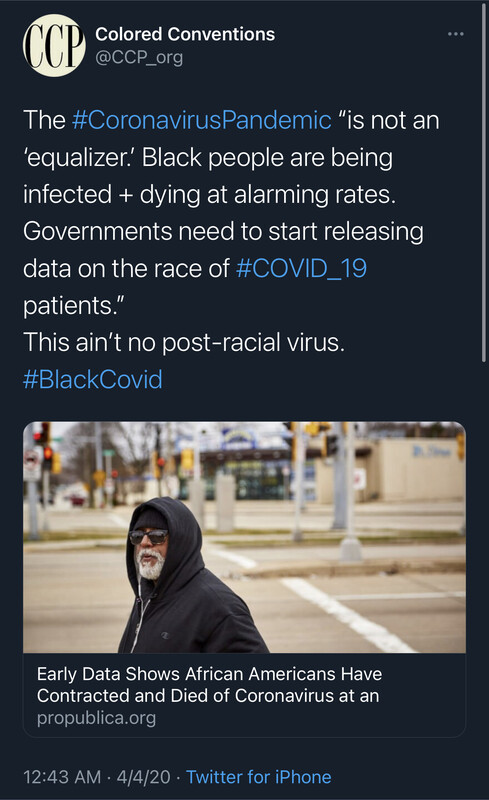
This post shared on social media talks about how environmental, economic and political factors play key roles in the pandemic spread. Interestingly this article talks about the county Milwaukee, in which simply being black puts the life expectency down by 14 years. Dr. Camara Jones states in this article that "COVID is just unmasking the deep disinvestment in our communities, the historical injustices and the impact of residential segregation,”. As stated in the article, when mojority of black people in Milwaukee county went to near by hospitals when they felt they were in contact with the virus, they were sent home and died before the confirmation of the test came back. This shows how the pandemic is effecting black people.
-
2021-02-22
Art unleashes, intensifies, and celebrates precisely the creative and destructive impact of vibratory force on bodies, on collectives, on the earth itself: it protects and enhances life that is and announces life to come.
-- Elizabeth Grosz,
Chaos, Territory, Art: Deleuze and the Framing of the Earth.
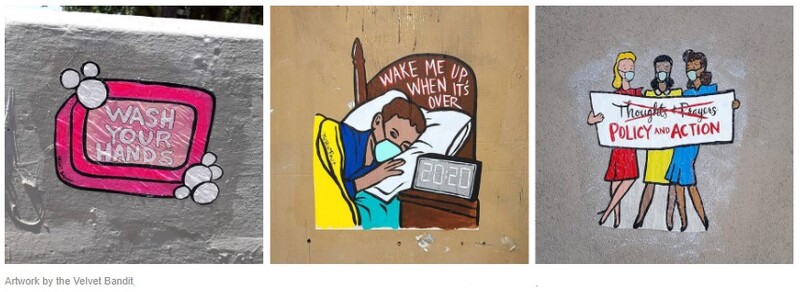
This call for submissions seeks to highlight street art in the Journal of the Plague Year (JOTPY), a Crowdsourced digital archive where anyone can add their experiences and responses to the global pandemic for future generations to witness.
Oftentimes, street art is temporary in nature and may be removed, obscured, or destroyed. Help JOTPY recognize the diversity of street artists and their expressions of the pandemic experience. Street art often reflects individuality, community sentiment, class differences, politics, emotion, and humor. Your contributions to the archive – such as news articles, blog posts, videos, photos, and social media posts of murals, graffiti, paste-ups, stencils, and stickers – will provide future generations access to a fleeting moment of art in and on public spaces and places during the pandemic.
When submitting a street art item to JOTPY, please include a title for your submission, a description and location of the street art, your name (names can be kept private/anonymous), and #pandemicstreetart. Text stories, image(s), video(s), audio, and PDF files are all accepted file types. If the street art speaks to your experience(s) of the pandemic, please share your thoughts!
If you would like to contribute, please share your story/pic/video here and reach out to Monica Ruth at meruth1@asu.edu if you have any questions.
-
2021-02-22
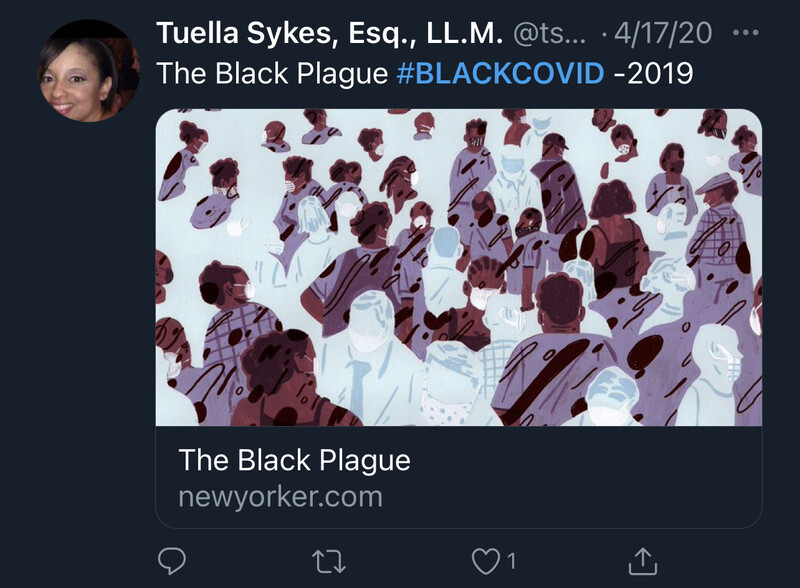
This post tags an article titled "The Black Plague" which states that according to the Reuters report African Americans are more likely to die from Covid-19 than any other group in the U.S.. The article goes further in to explain the synopsis of affected and deaths of certain states but it importantly states that black people are more likely to have pre-existing health conditions that weaken their immune systems causing them to be easily infected. Though this is one reason why; other reasons including, as stated in the article "Trumpanian Malfeseance" is another major cause. With the testing locations around the U.S having major breakpoints, it was noted that zipcodes of higher-income families had the closest and many available sights of getting tested compared to zip codes with low-income families. Further studies showed that out of these lower-income locations, the majority was filled by black people. This limited the opportunity for black people to get tested and explains how the pandemic is affecting black people.
-

2021-02-22
**story in file
-
2021-02-22
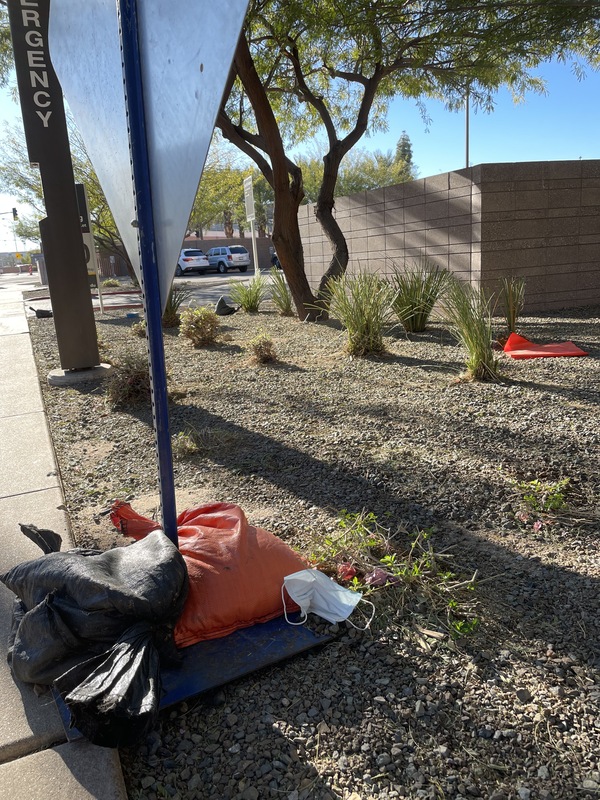
Disposable mask spotted en route from the Tempe transit center to the Childhood Development (Psychology building) on Campus along Veteran's Way. 33°25'21.0"N 111°55'45.3"W
-
2021-02-20
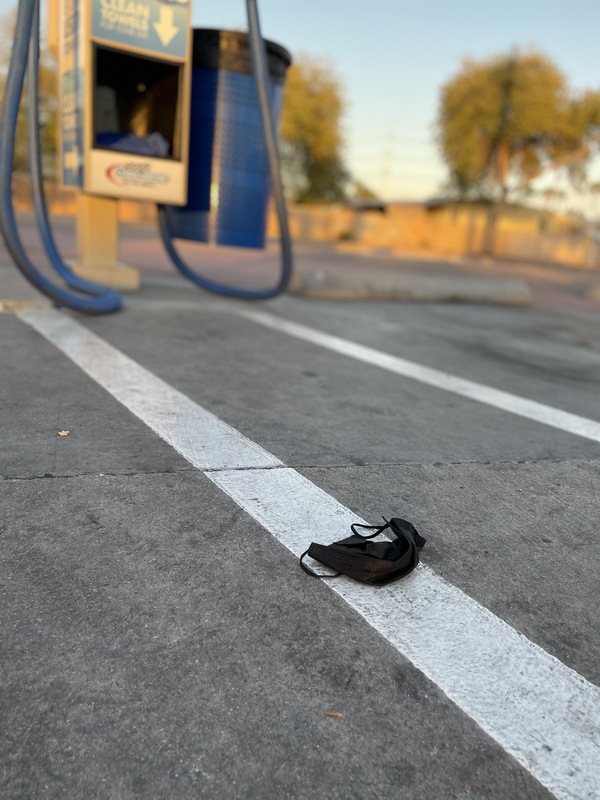
I saw this black, disposable mask while vacuuming my van on Saturday at Cobblestone Auto Spa. I picked it up and threw it away before it blew into the water channel.
-
2021-02-19
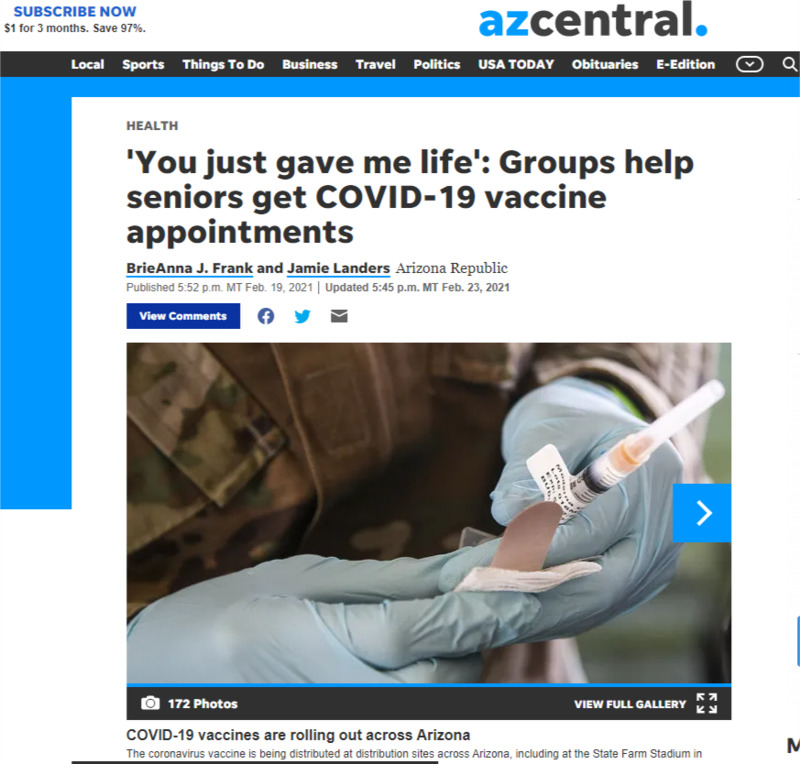
The elderly of Arizona are having difficulty sign-up for a COVID-19 vaccine. Issues with the state website and difficulty accessing technology seem to be the main causes. The ADHS is working on making the website more functional and is using an appointment hotline to combat the issue. Local groups are also assisting the elderly with making appointments.
-
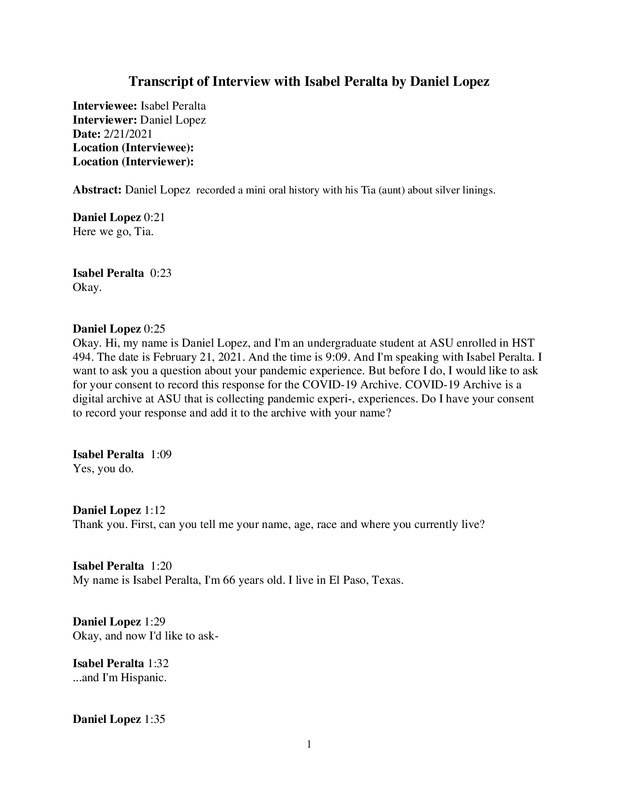
02/21/2021
I recorded a mini oral history with my Tia (aunt) about silver linings.
-
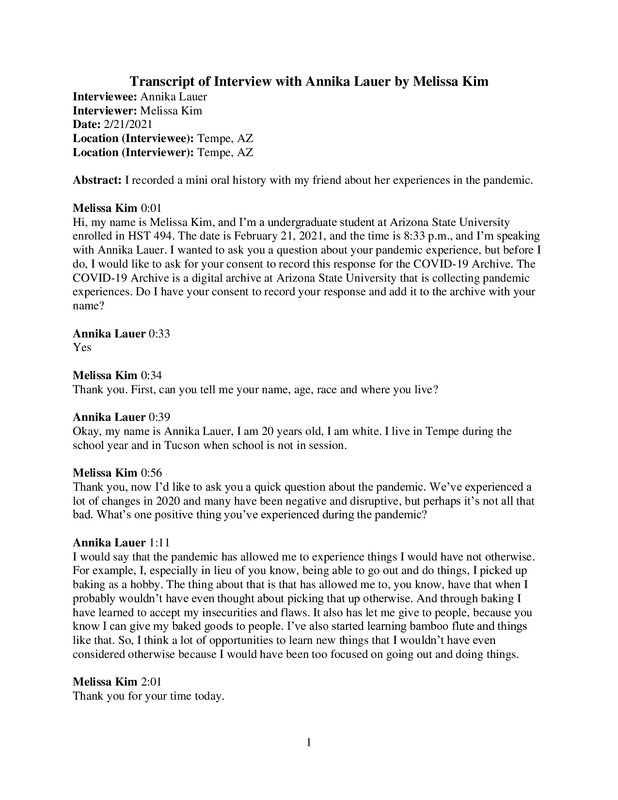
02/21/2021
I recorded a mini oral history with my friend about her pandemic experiences
-
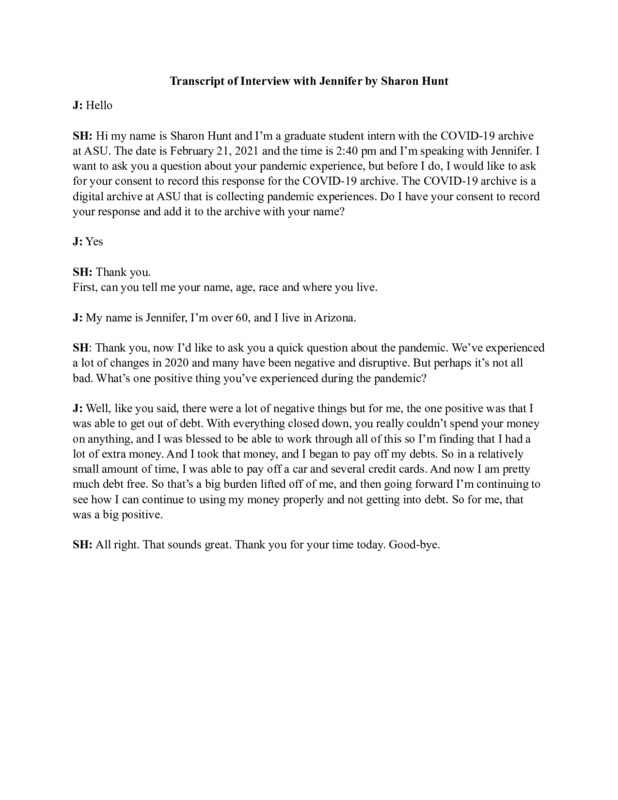
2021-02-21T14:40
Transcript of Interview with Jennifer by Sharon Hunt
Interviewee: Jennifer
Interviewer: Sharon Hunt
Date: 2/21/21
Location (Interviewee): Tucson, Arizona
Location (Interviewer): Tucson, Arizona
Transcriber: Sharon Hunt
Abstract:
Jennifer lives in Tucson, Arizona, and spoke about a positive result of the pandemic that she has experienced. She has been able to save money and pay off debts during this time period, as she has not been able to go out and shop or go to restaurants as she did in pre-pandemic times.
-
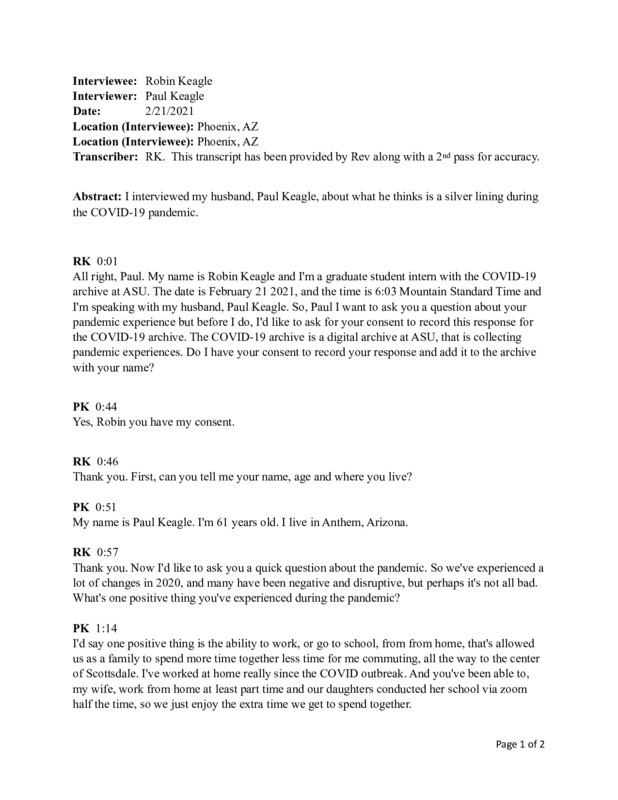
02/21/2021
This is a mini oral history with my husband, Paul Keagle, regarding silver linings during the pandemic.
-
02/21/2021
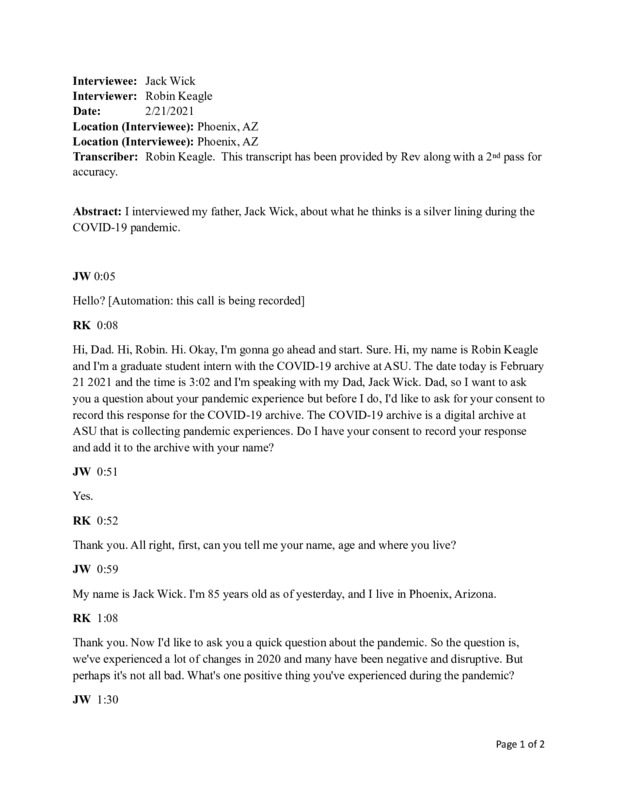
This is a mini oral history interview with my father, Jack Wick, regarding silver linings during the pandemic.
-
2021-01-24
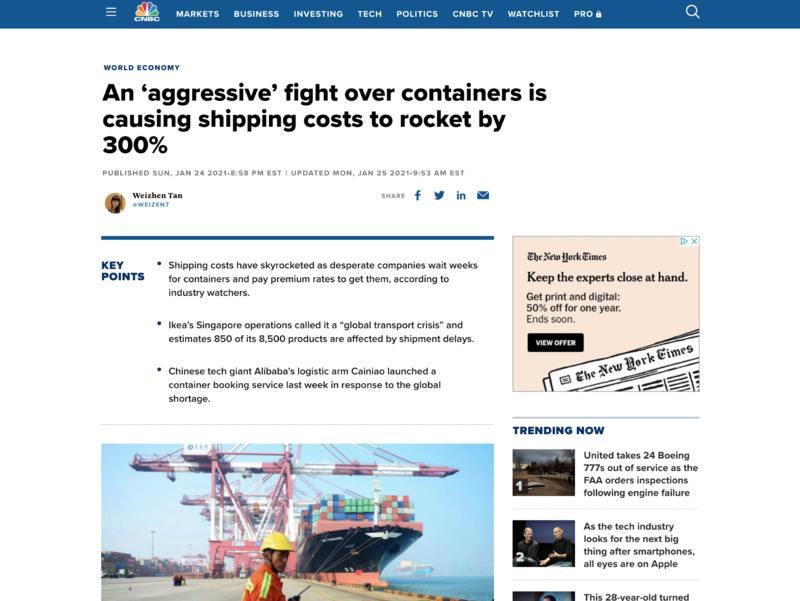
Container Crisis Brought About By COVID
The US imports 3 containers of Chinese goods
whilst exporting only 1 container of goods
-
2021-02-15
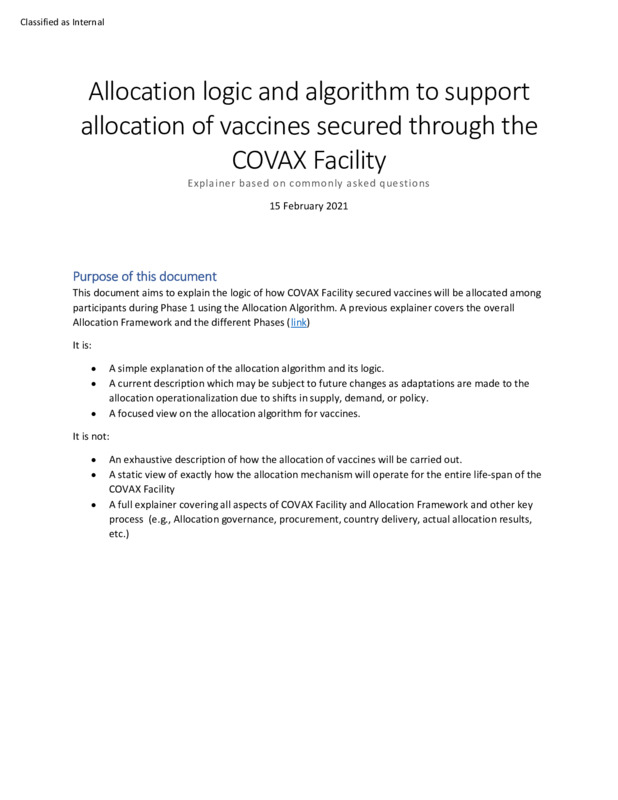
COVAX - The initiative to help supply vaccines to poor countries FEB 15 publication.
-
2020-06-01
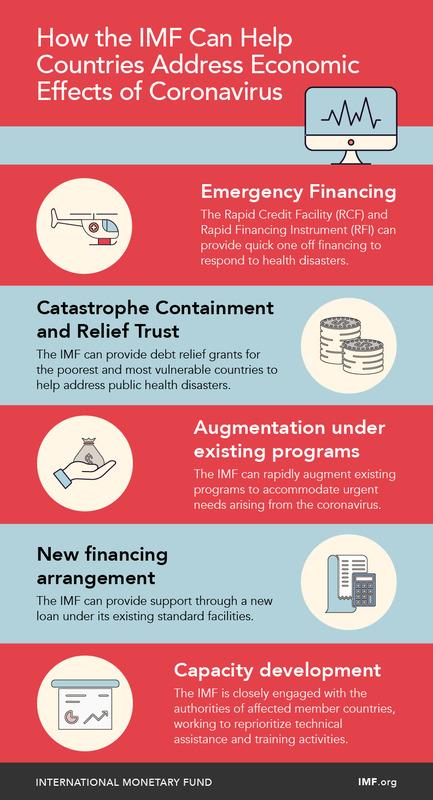
Covid finance options by IMF
-
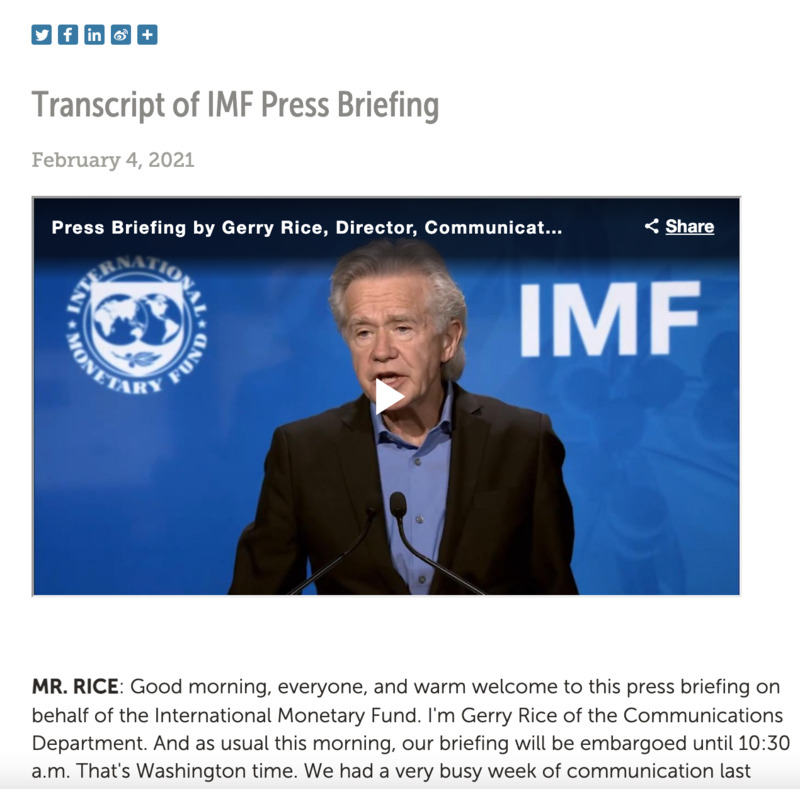
2021-02-04
Questions Reporter Asked IMF Gerry Rice [ Director, Communications Department, IMF ]
concerning Myanmar COVID Relief Money
QUESTIONER: In terms of Myanmar, recent developments in Myanmar. It seems that quite recently, just before the coup, that the IMF had given some $350 million and dedicated it toward it. I'm wondering what are your thoughts? First of all, what are the IMF's thoughts, obviously, on the coup? But also generally, how did the IMF react when there's a change of government in this way right after they've given money? Is there any -- how can you assure that the money goes, you know, for the intended purposes? That it doesn't actually support a now more military government? That's my question for today.
MR. RICE: Thank you very much for that. We are, of course, very concerned about the impact of recent events and what they could have on the people of Myanmar, and we're watching it very closely, of course, like the rest of the world. Just to remind that, of course, Myanmar faced large economic and social costs as a result of the pandemic, and the IMF resources, our support was to help the people of Myanmar to meet these urgent humanitarian needs. That was the whole purpose.
Again, just to set in context, the approval of this supports was back in January by our board and followed all standard procures for this kind of emergency financing. The same as we have done for another 84 countries in this crisis, and standard safeguards in place regarding the resources, including the repayment schedule. And as I think you know, the IMF's record over 75 years on repayment and safeguarding of IMF resources is very clear. In terms of the status of our engagement, we have had no communication at this point with the new regime, and that's about as much as I have at the moment on Myanmar.
QUESTIONER: So I had a question to follow up on Myanmar. I'm just wondering, on what happens [next]? Do you have to wait until whatever government emerges to reach out to the IMF to see if there's going to be even a relationship with the IMF going forward? And, you know, some people that I've spoken with are suggesting that well, this is kind of a pitfall of these rapid disbursing instruments that have been used. The money goes out very quickly all at once with no or very few conditions attached to it. Is there any thought to changing that at this stage and, you know, just wondering what next steps are on this? Is it just waiting till the smoke clears to decide how we engage? Also, the military generals that were appointed, a new central bank chief who was the same guy that ran the central bank when they were in power. Is there some concern that the central bank will lose its independence?
MR. RICE: Just on your last point, of course, the independence of central banks is one of the fundamental principles that the IMF believes in and supports so, you know, just to make that very clear. On your other points, clearly the situation is unfolding. In terms of recognition of the government as in other cases, we are guided by the international community, guided by the membership in terms of recognition of the government. So again, the situation is unfolding there but that's what guides us in terms of our relationship with countries.
You know, what I'd say on how the resources that we approved back in January how they are used, clearly again, as I said, these resources were for a clear purpose, the crisis, the pandemic, the helping with the humanitarian needs there. And, of course, it would be in the interest of the government and certainly the people of Myanmar that those funds are indeed used accordingly. Under the arrangement that was agreed with the previous former government, there was indeed safeguards regarding how the funds would be used as is the case with all of our emergency financing. I've talked about it here before. That included audit and, you know, transparency of how the resources are used. And again, this is true for all of the emergency financing. So while there are few conditions, as you rightly say, there are safeguard provisions and it would be our expectation that, you know, regardless of the future that these commitments would be maintained. Because those resources need to go to support the people and especially vulnerable groups.
So you asked finally where we’re thinking of changing. You know, again, we've been using these emergency financing instruments in 85 countries so far. I think they have been a huge help and assistance in the crisis especially to the poorest countries, to low income countries. And I think one of the reasons that they've been so effective and we've been able to get the support so quickly is the, you know, the conditions are relatively few. However, and again I stress, the safeguards and the governance of those resources is something that we give high priority to and each one of those has a set of safeguards. Whether it's audit or publishing of procurement contracts, you know, there's a whole series of governance related provisions that we have attached to these loans. These are very important and we're confident that the resources will be well used and for the purpose that they were intended in these emergency financing loans.
-
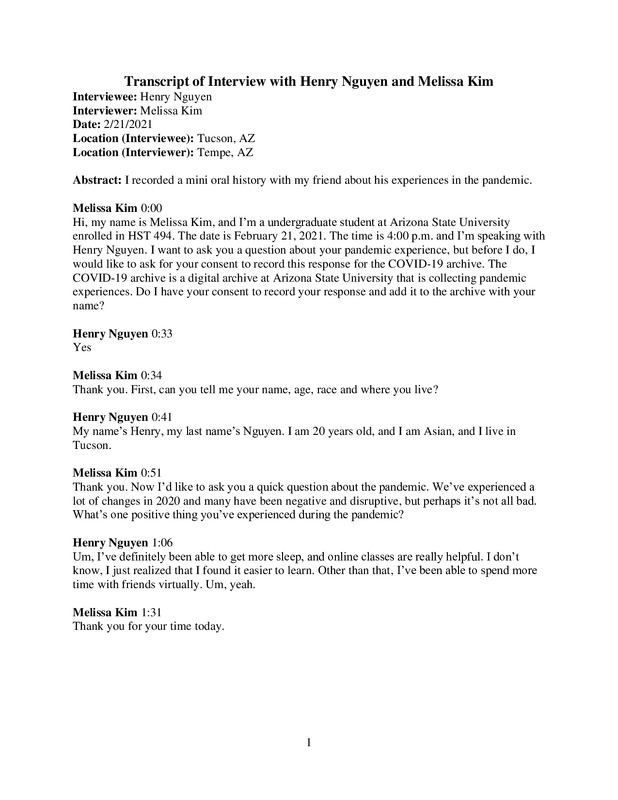
02/21/2021
I recorded a mini oral history with my friend about his experiences in the pandemic.
-
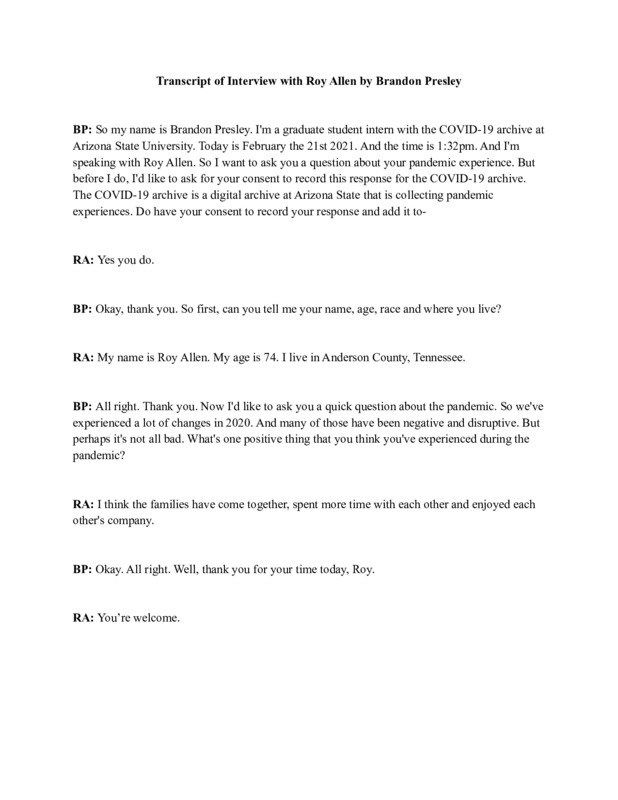
2021-02-21
This is an oral history with my grandfather, Roy. Roy believes that the silver lining from the pandemic was how much closer families are today than they were before.
-
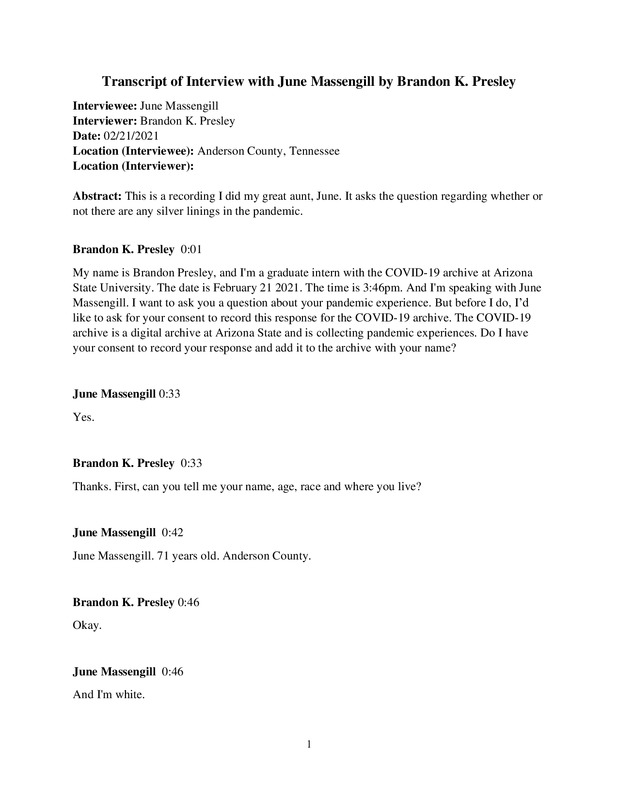
02/21/2021
This is a recording I did my great aunt, June. It asks the question regarding whether or not there are any silver linings in the pandemic.
-
02/21/2021
This is a mini oral history that I did with Nancy Carter, my mom, about silver linings
-
02/21/2021
This is a mini oral history that I did with George Carter, my dad, about silver linings
-
2020-04-20
When the going gets tough, the tough get going...
I think I understand the meaning of hunkering down and getting to work now. I have always loved creating and now more than ever am embracing its healing powers.
During these last six weeks I feel like we have been dodging bullets. We have become hunter gatherers looking for supplies to combat the germs. We are obsessed with stocking our little fort with enough of everything (art supplies), to survive the war.
Through it all, my husband and I have also been obsessed with creating. Me in my home studio, learning how to collage, make books, creating paintings, greeting cards and finding new techniques to immerse (distract) my self. My husband in his shop behind our house making cigar box guitars!
I read a quote from J.R. Tolkien, The Fellowship of the Ring, that sums up, like most things, will be our attitudes that will help us accept this interruption of life.....
”I wish it had not happened in my time”. said Frodo.
”So do I,” said Gandalf, “and so do all who live to see such times.
But that is not for them to decide.
All we have to decide is what we will do with the time that is given to us.”
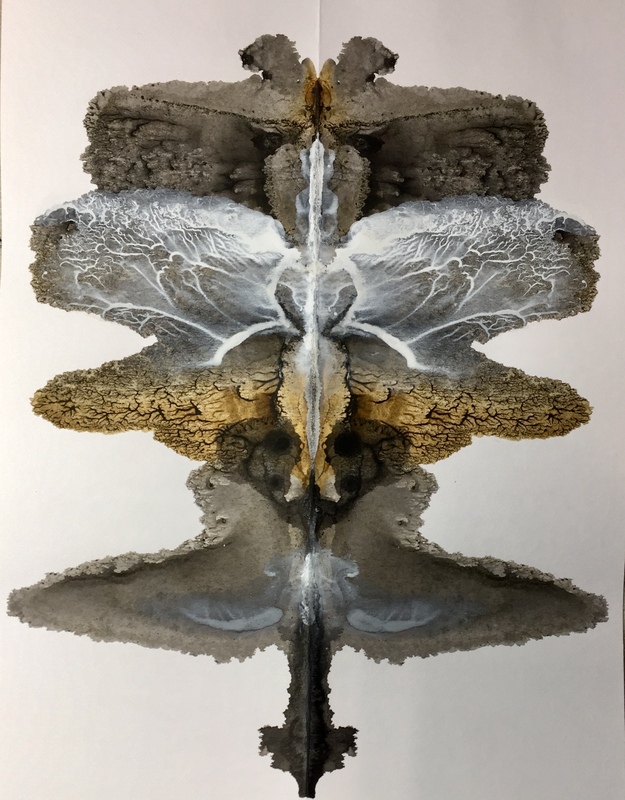
Since the start of the pandemic I have created over 65 paintings. I need to create in order to find sanity and feel productive and not scared and anxious. The photograph is a painting I created using Rohrshadk blots as inspiration.
-
02/21/2021
This is a mini oral history of Eva Ruth by Monica Ruth, about the silver lining of the pandemic experience.
-
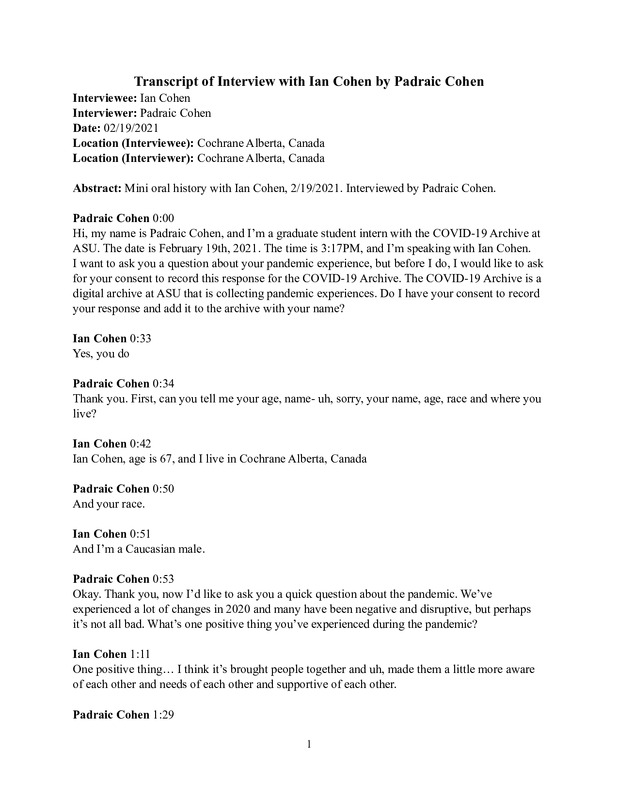
02/19/2021
Mini oral history with Ian Cohen, 2/19/2021.
Interviewed by Padraic Cohen
-
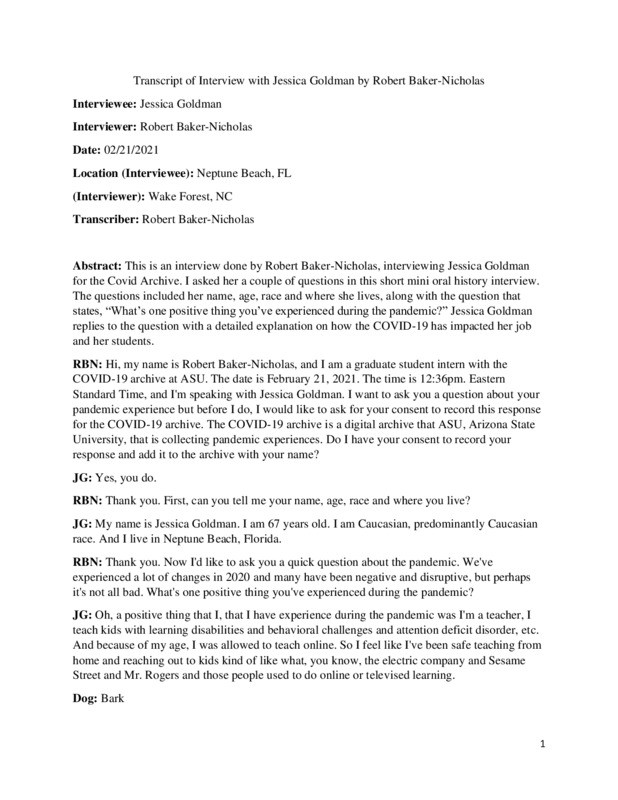
2021-02-21
This is an interview done by Robert Baker-Nicholas, interviewing Jessica Goldman for the Covid Archive. I asked her a couple of questions in this short mini oral history interview. The questions included her name, age, race and where she lives, along with the question that states, “What’s one positive thing you’ve experienced during the pandemic?” Jessica Goldman replies to the question with a detailed explanation of how the COVID-19 has impacted her job and her students.
-
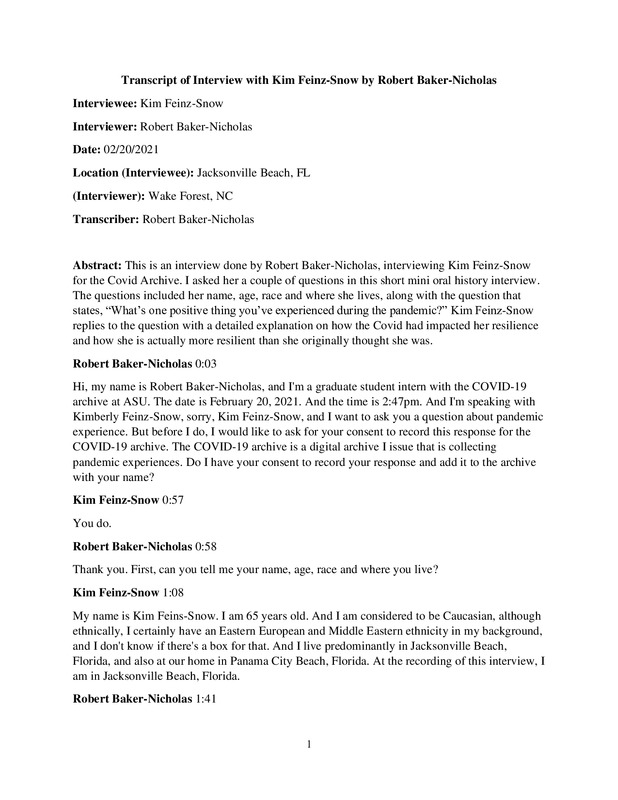
02/21/2021
This is an interview done by Robert Baker-Nicholas, interviewing Kim Feinz-Snow for the Covid Archive. I asked her a couple of questions in this short mini oral history interview. The questions included her name, age, race and where she lives, along with the question that states, “What’s one positive thing you’ve experienced during the pandemic?” Kim Feinz-Snow replies to the question with a detailed explanation on how the Covid had impacted her resilience and how she is actually more resilient than she originally thought she was.
-
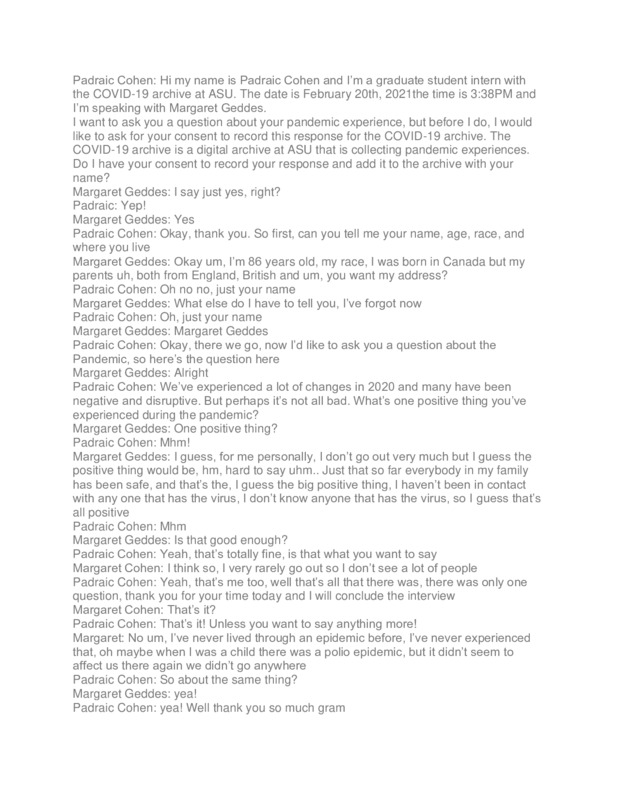
2021-02-20T15:38
Mini oral history with Margaret Geddes, 2/20/2021
Interviewed by Padraic Cohen
-
02/20/2021
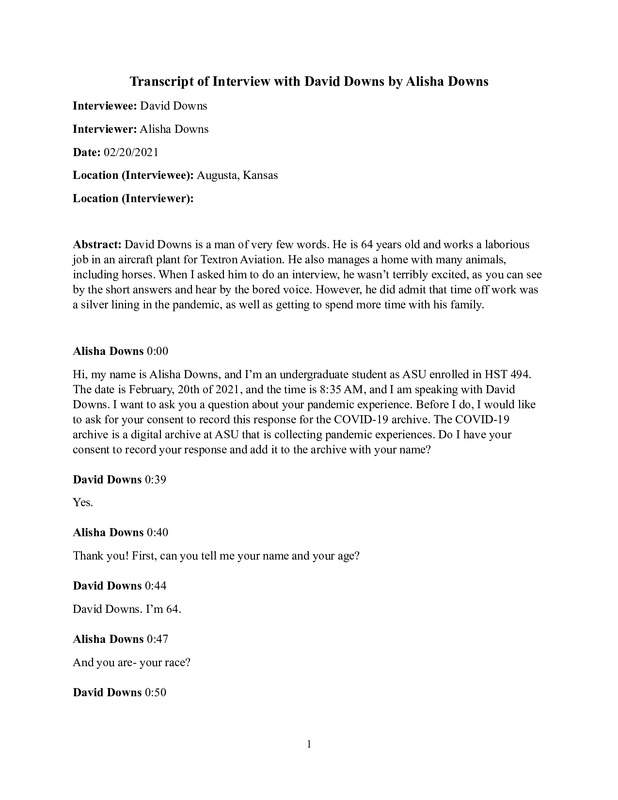
David Downs is a man of very few words. He is 64 years old and works a laborious job in an aircraft plant for Textron Aviation. He also manages a home with many animals, including horses. When I asked him to do an interview, he wasn’t terribly excited, as you can see by the short answers and hear by the bored voice. However, he did admit that time off work was a silver lining in the pandemic, as well as getting to spend more time with his family.
-
02/20/2021
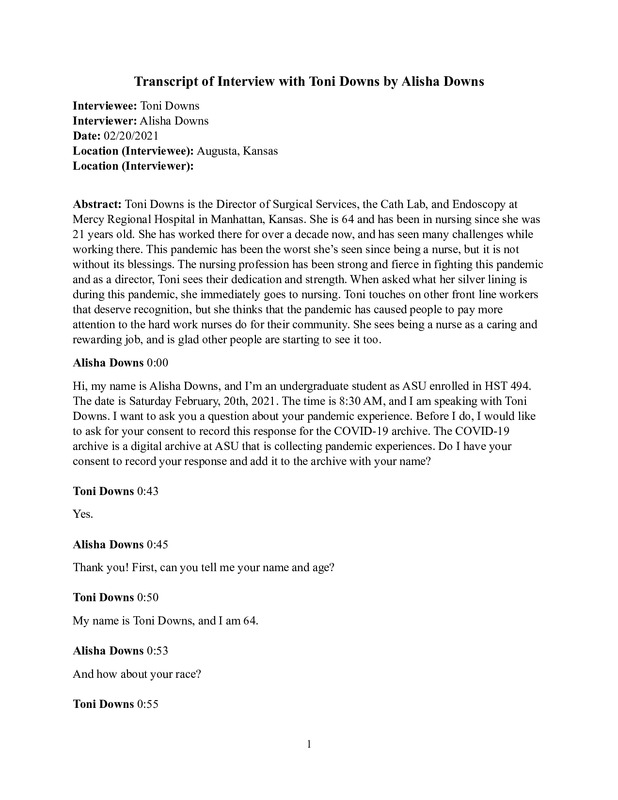
Toni Downs is the Director of Surgical Services, the Cath Lab, and Endoscopy at Mercy Regional Hospital in Manhattan, Kansas. She is 64 and has been in nursing since she was 21 years old. She has worked there for over a decade now, and has seen many challenges while working there. This pandemic has been the worst she’s seen since being a nurse, but it is not without its blessings. The nursing profession has been strong and fierce in fighting this pandemic and as a director, Toni sees their dedication and strength. When asked what her silver lining is during this pandemic, she immediately goes to nursing. Toni touches on other front line workers that deserve recognition, but she thinks that the pandemic has caused people to pay more attention to the hard work nurses do for their community. She sees being a nurse as a caring and rewarding job, and is glad other people are starting to see it too.